




Lorem ipsum dolor sit amet, consectetur adipiscing elit. Suspendisse varius enim in eros elementum tristique. Duis cursus, mi quis viverra ornare, eros dolor interdum nulla, ut commodo diam libero vitae erat. Aenean faucibus nibh et justo cursus id rutrum lorem imperdiet. Nunc ut sem vitae risus tristique posuere.
In that delicate hinge of dawn and dusk, the world holds its breath. Darkness becomes a medium, the veil thins, first breaths are drawn, and departing souls exhale their last. The Pillars by Reuben Paterson is the invitation and an opening into this suspended, shimmering threshold. To enter is to move among living trees rising as kaitiaki, parting the ordinary to make way for a realm where whakapapa flows in multiple directions, where past, present, and emergent time coexist without hierarchy. Foreground and background collapse; human and non-human, earthly and stellar, ancestral and speculative move together. And like all thresholds, it requires an invitation—an opening of the senses, a calling-in, a small spell to mark the crossing. In this world, beings hold attention without fear, without hurry, as if harm itself has been suspended, turning gently toward us, welcoming our presence into their place.
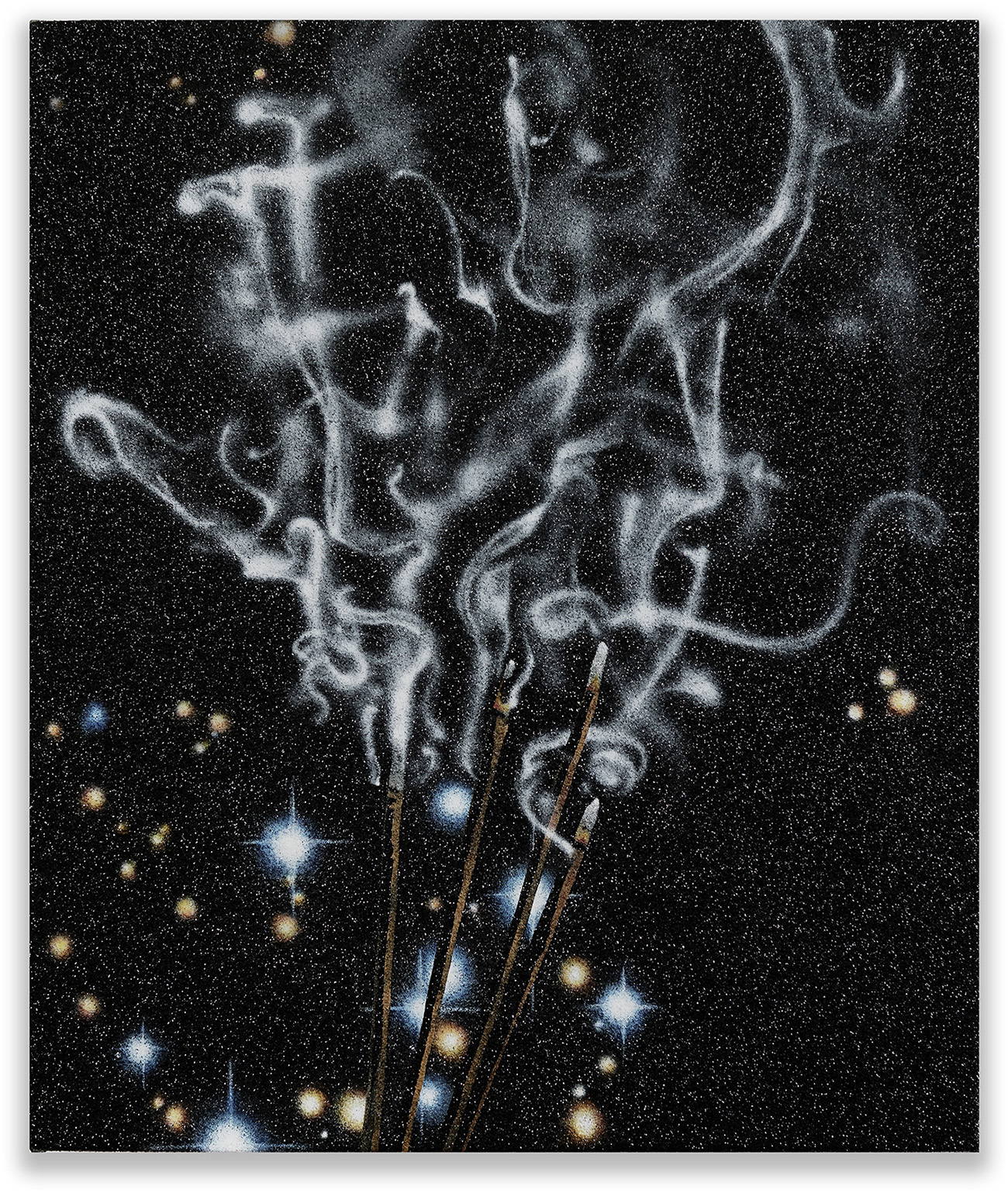
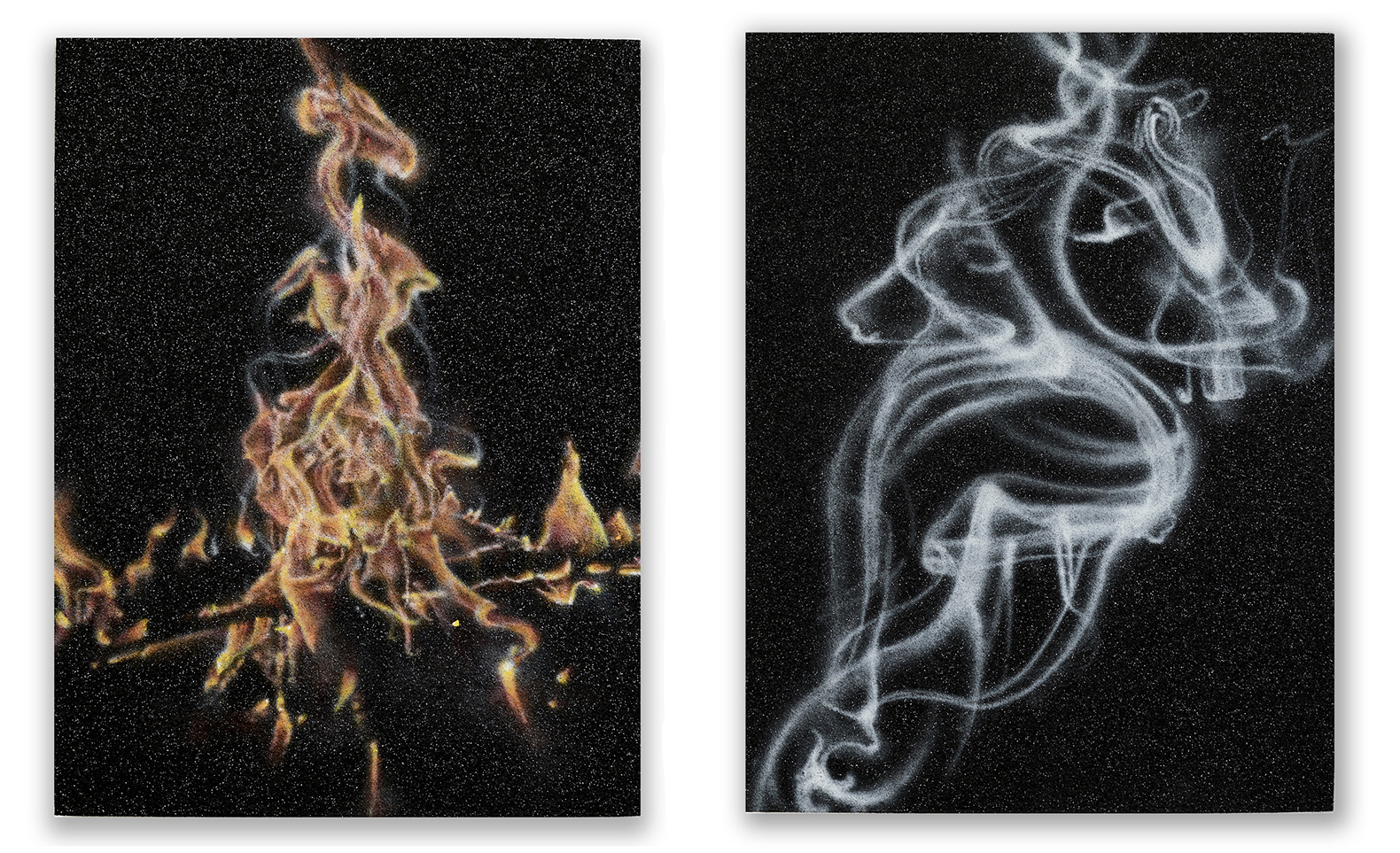
Announced by a slow, curling drift of sandalwood, rising like soft, luminous instruction: to be present, to arrive, to remember. The ordinary pace of the day loosens its grip. Elsewhere, fire rests in its most vulnerable state, neither roaring nor extinguished, caught in that suspended moment where potential and memory converge. Smoke winds in slow arabesques, romantic and ritualistic, marking a space that has been cleared, blessed, transformed. These are states of being, speaking to patience and impatience, to cycles that begin and end without clear markers, to the eloquence of a time that cannot be fixed. Here, culture, spirituality, memory, and imagination cohabit, and the work begins to move with the logic of magical realism.
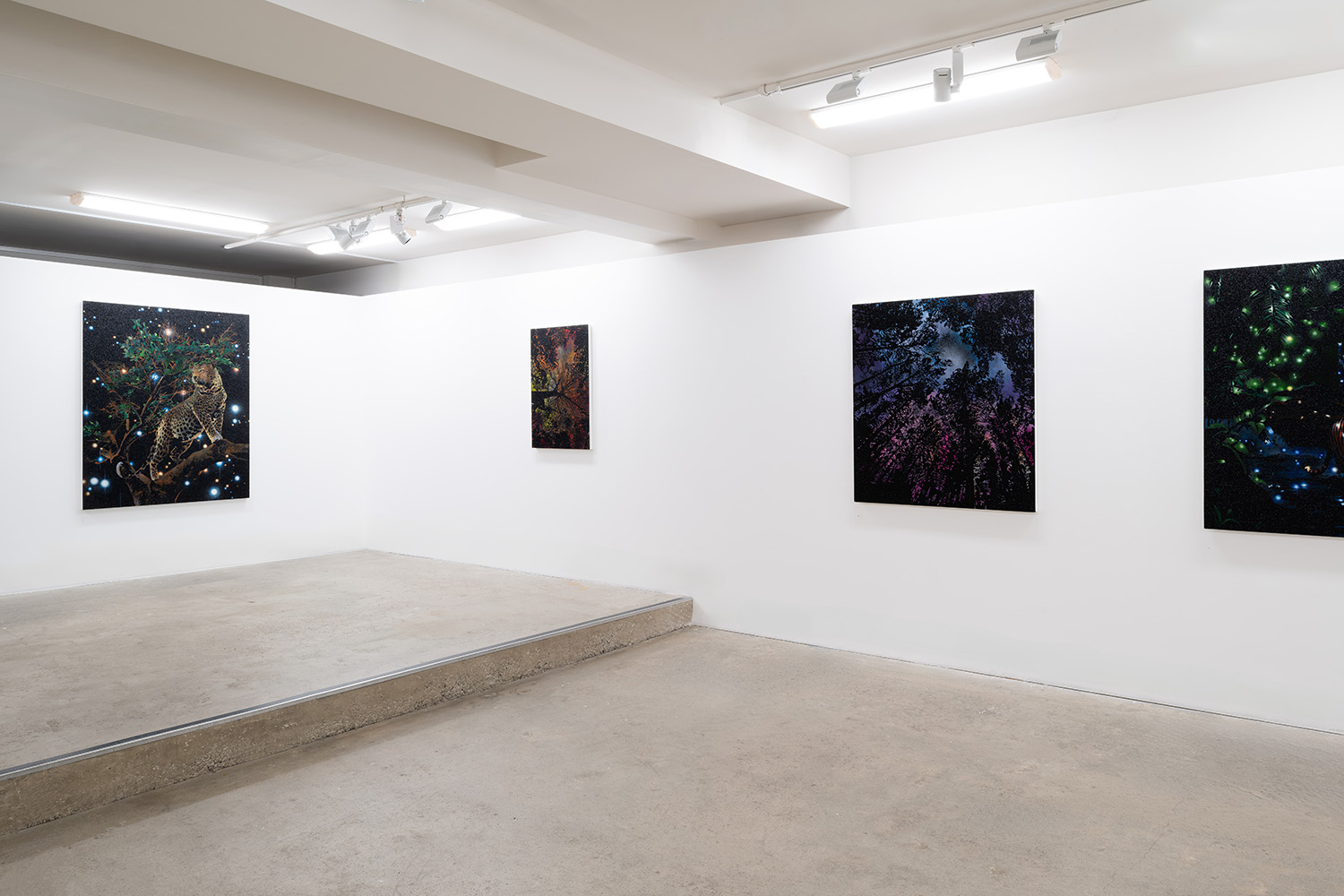
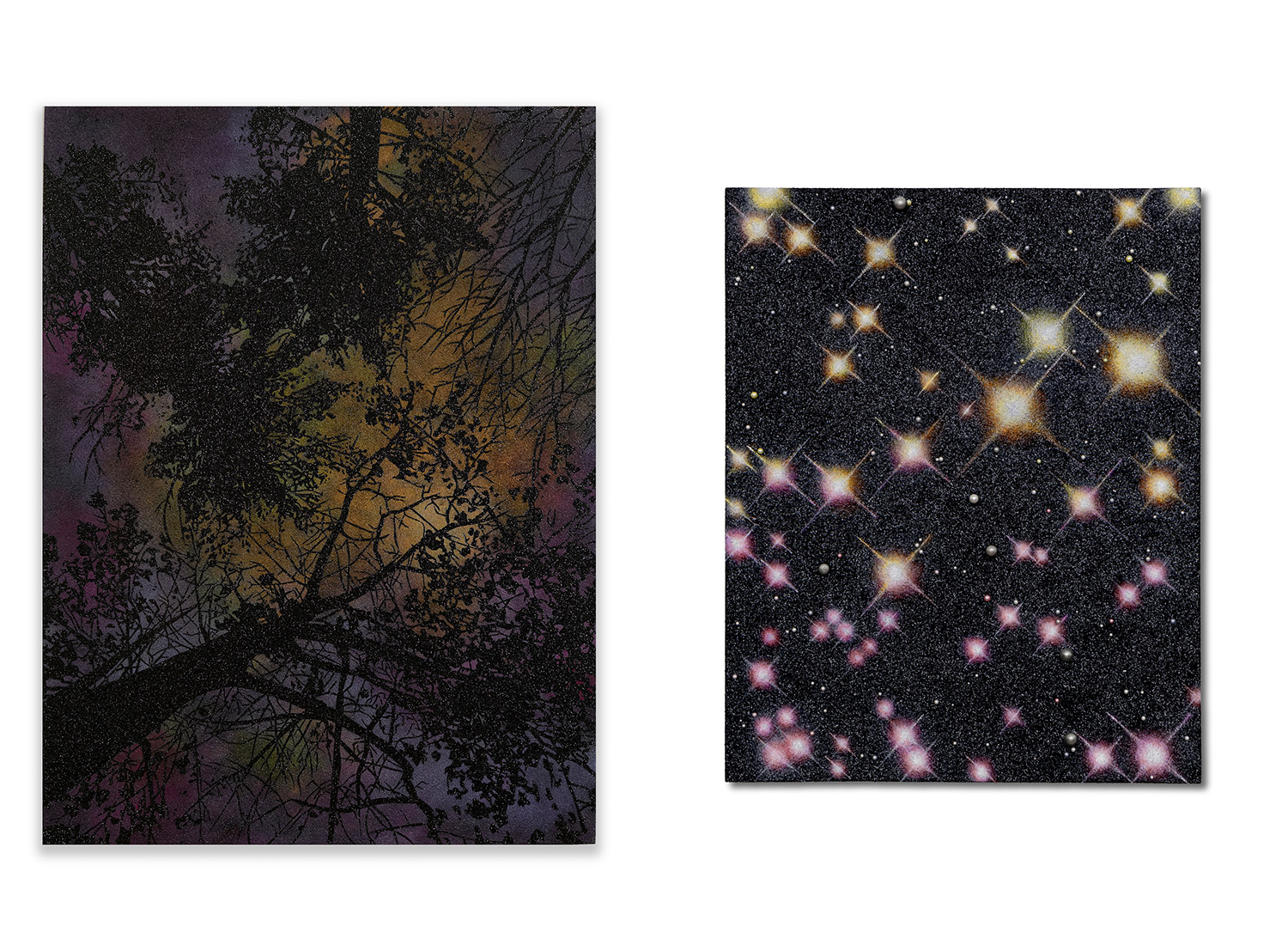
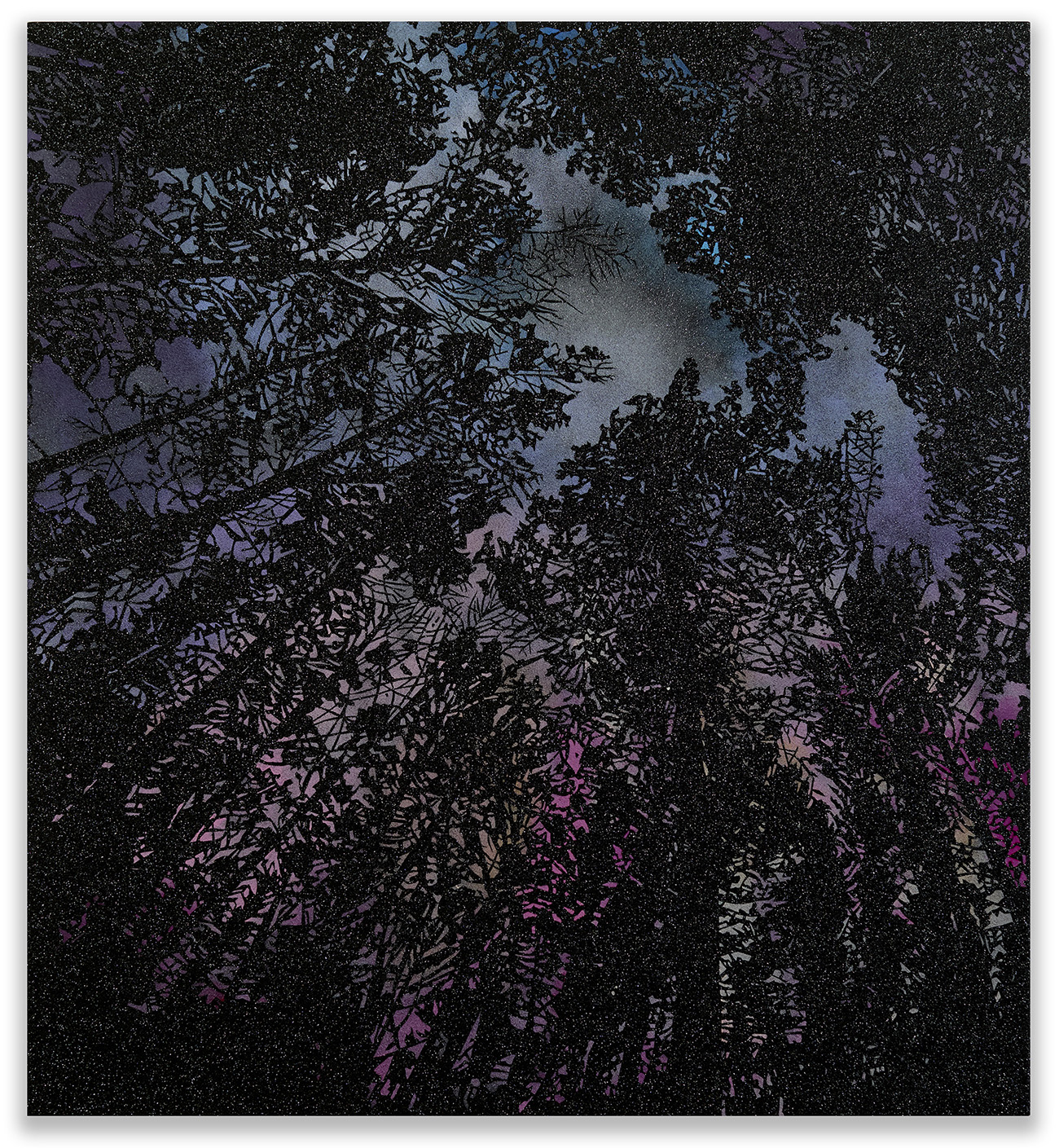
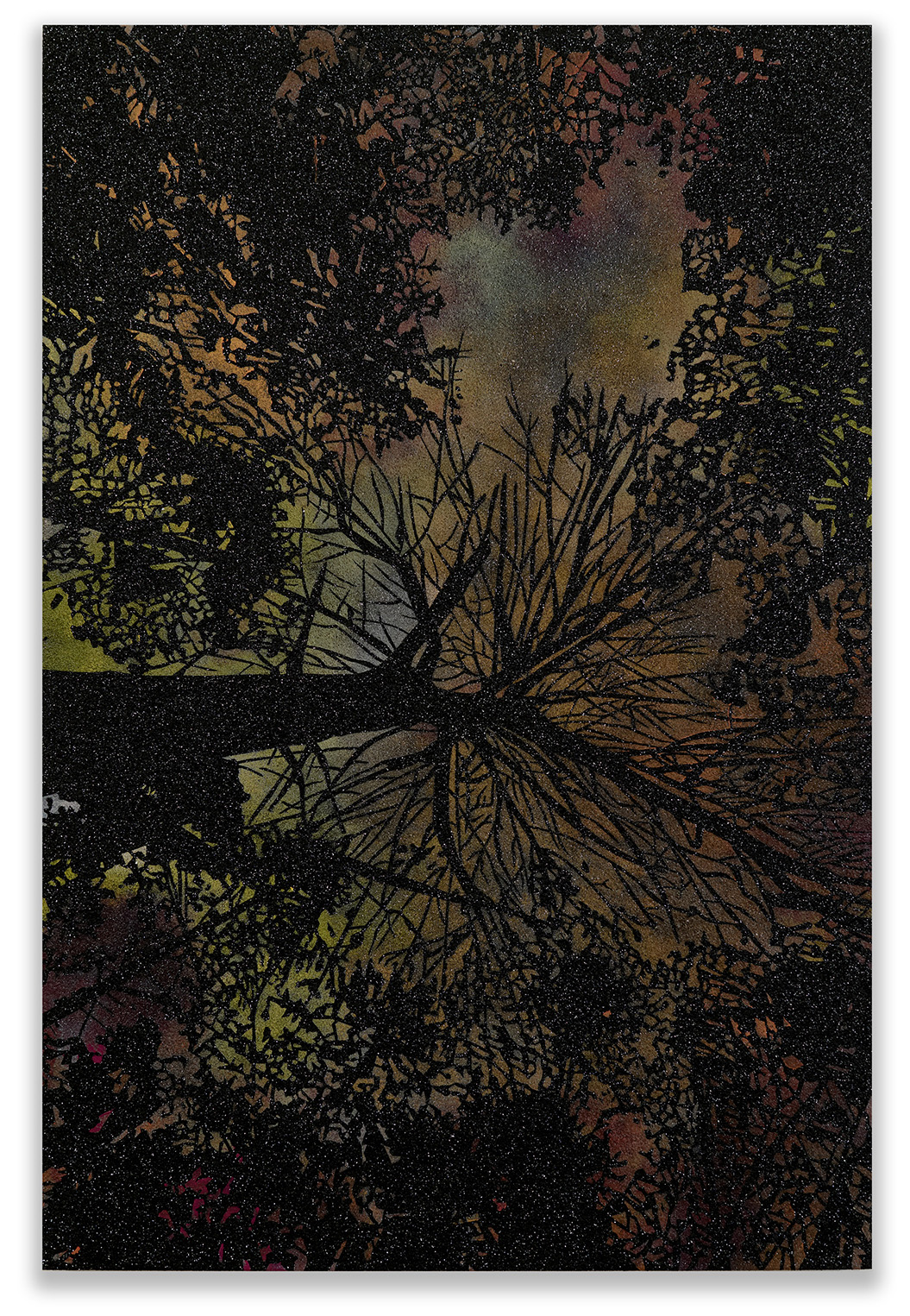
Look into the canopy works and feel yourself sinking into the forest floor, gaze tracing branches into a sky suspended between night and day. It is the crepuscular hour when insects stir or silence falls, when the air holds both warmth and chill. Your body registers the shift first; limbs loosen, breath deepens, senses widen, and in that suspended moment, the world of the paintings settles around you, delicate, alive, and impossible to separate from your own experience.
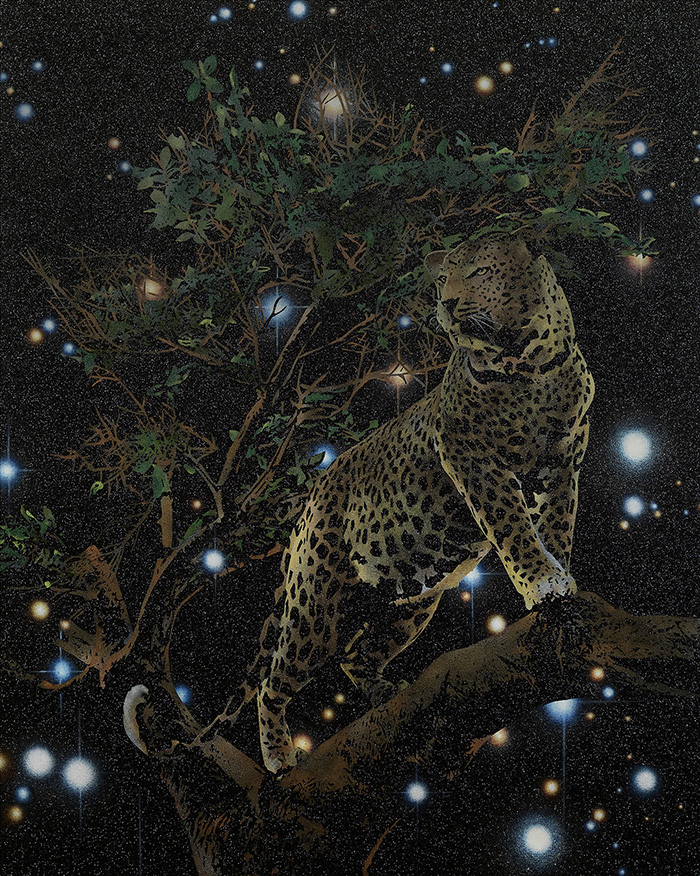
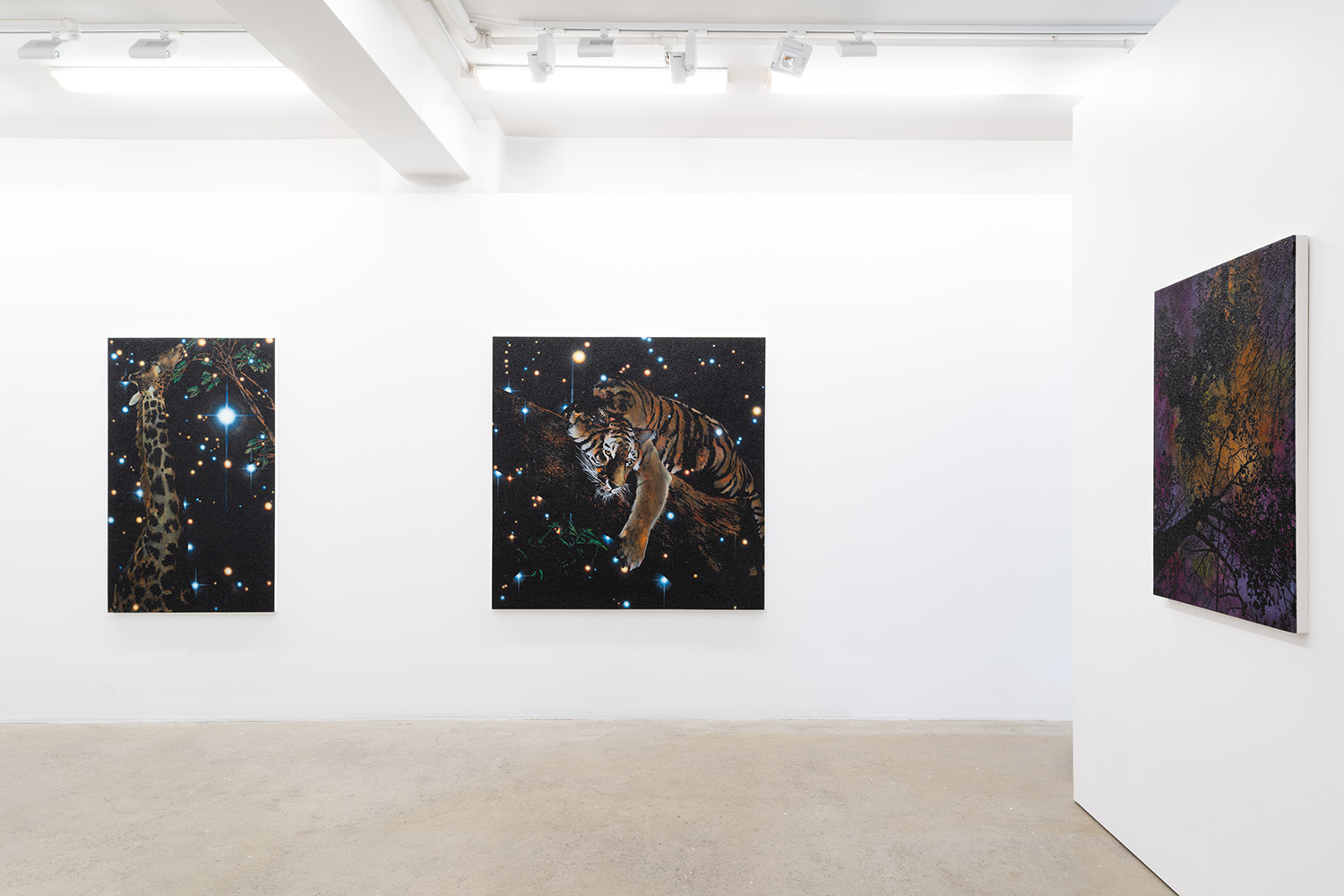
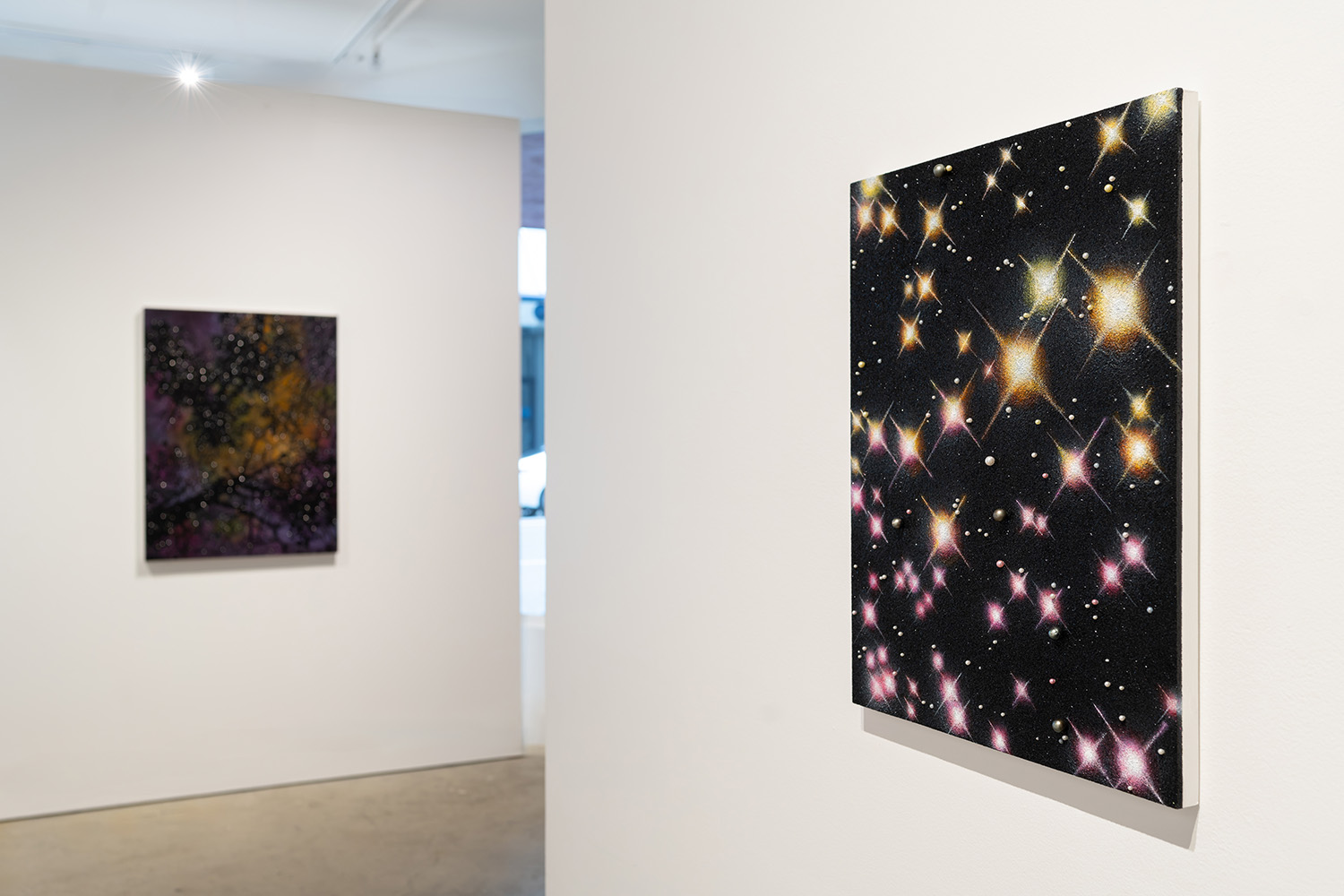
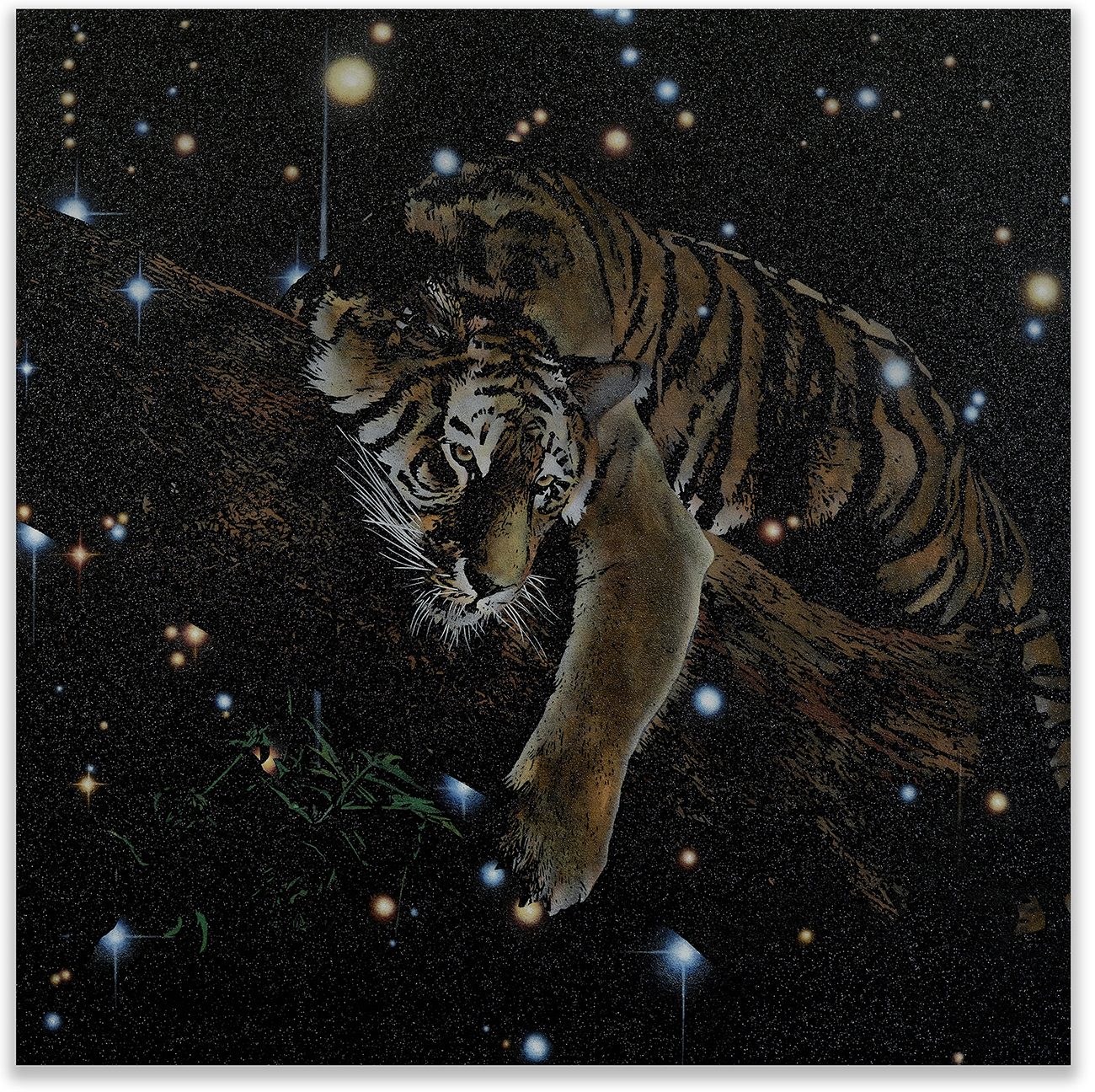
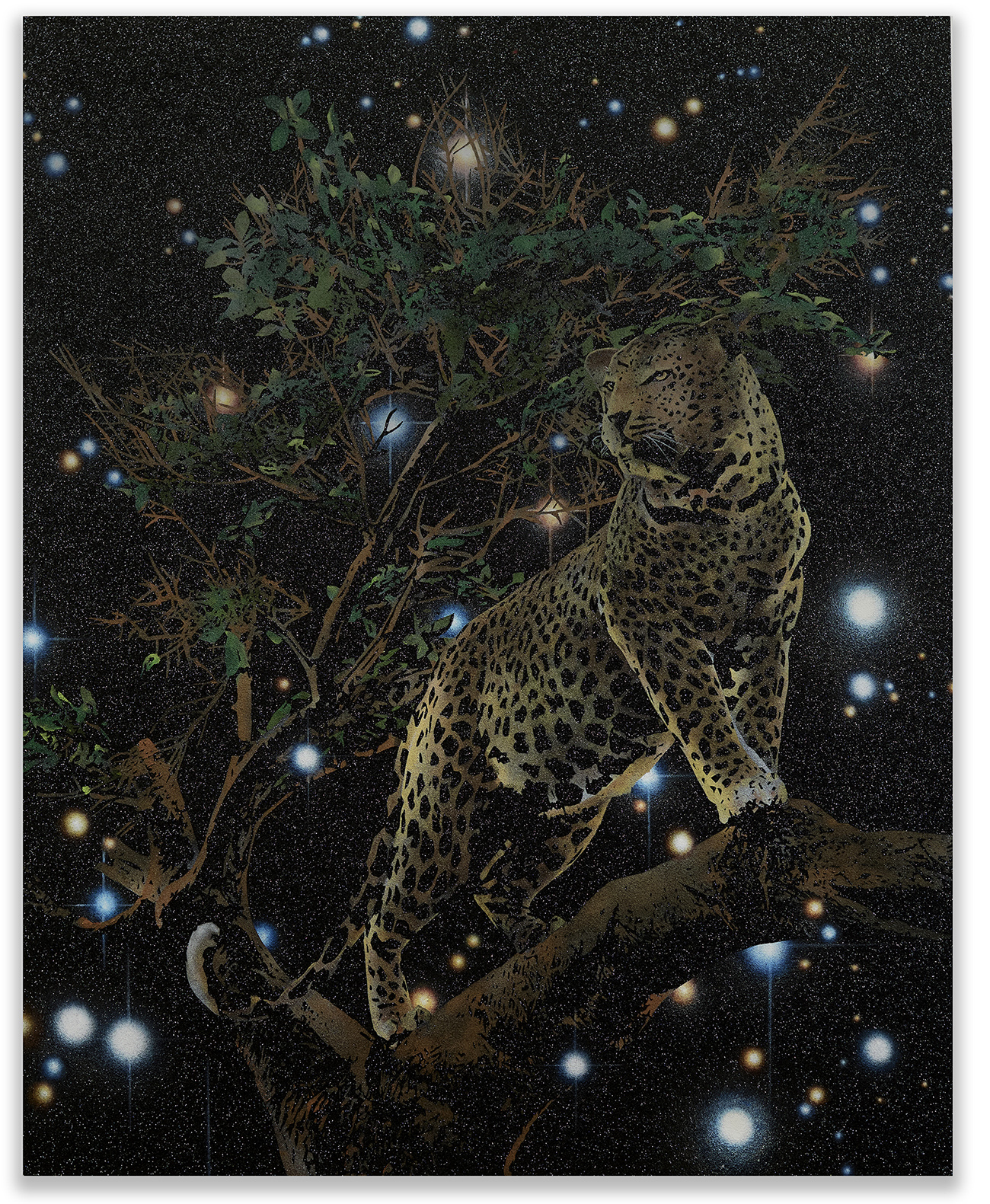
Reuben Paterson paints his protagonists with a precision that borders on devotion. A line of light travels along the crook of a tree that feels at once like shelter and altar for a large reclining tiger. A star pierces the darkness behind and becomes the glint that defines the curve of its claw. Shadows slip forward, planes merge, depths unfold. You are not simply looking at an image. The extraordinary is embedded, breathing inside the ordinary until the two can no longer be separated. A small constellation of presences holds this world open, each one tethered to a constellation precisely mapped from Hubble, each one a point of navigational orientation in a sky that is also forest, body, and genealogy. They are witnesses. Their bodies are alert but untroubled, understanding the delicate balance of forces that pass through this realm. They hold authority without violence, power without domination; a sovereign stillness that steadies the space around them. A pregnant jaguar carries the future in her body: the continuation of whakapapa made visible. She is not only herself. She is us —mother, grandmother, the mitochondrial line carried intact across generations. In her stillness there is no fear.
A tiger’s flank. The lifted line of a giraffe’s neck catching light like a horizon. Branches, trunks, canopies. Everywhere, wood, and the vertical insistence of trees. The trees are the structure of the world. They are pillars in the most literal and the most cosmological sense. They hold the space upright, they carry the weight of sky, they are ladders, conduits between ground and something beyond it. In their bark and shadow they hold memory; in their height they promise ascent. Paterson’s paintings operate in this same register. They ask you to expand what you understand as real, to notice what flickers at the edge of perception.
In literature, writers like Gabriel García Márquez and Ben Okri have long used the method of magical realism to convey truths that exceed the limits of plain realism. In One Hundred Years of Solitude and The Famished Road, the supernatural is simply part of the world. Ancestors return. Spirits walk alongside the living. Time bends, loops, dissolves. These are expressions of reality itself. In Aotearoa, Witi Ihimaera’s The Whale Rider occupies a similar space, where whakapapa, the non-human world, and the presence of ancestors move through the everyday without needing to be declared as extraordinary.
It is not only technical mastery—though that is undeniable—but the way that mastery is put to work inhabiting a reality contiguous with ours yet not bound by it. Foreground, background, and subject refuse their assigned places. Light travels across surfaces, reorganizing your sense of depth.
The pillars, then, are more than trees. They are conditions of possibility. They hold open a space where multiple temporalities coexist, where ancestry, spirituality, and the more-than-human move freely without translation or explanation. They offer a vertical axis along which you can travel—bodily and imaginatively—from ground to sky, from the visible to the felt. They remind us that reality is never singular: it is layered, carried in bodies, in land, in memory, in the deep knowledge systems that have always persisted alongside, beneath, and beyond colonial rationalism. Paterson’s paintings let you feel it.
In a world that often feels unrecognisable, this body of work does something radical. It reminds us that even amidst disarray, connection is possible. It does what trees do. We are taught to see nature through competition, through hierarchies of survival. And yet forests move differently. Trees communicate. They share nutrients. They warn, repair, and protect. They shelter the young. They hold the vulnerable. They make worlds through relation. In this same spirit, The Pillars extends that care into human and imaginative realms. It is a spell and a gesture that gathers us and holds space for a pluriverse:
May the thresholds open where light loosens into shimmer.
May dusk and dawn braid their time through ours until there is no before or after, only relation.
May we cross and cross again, radiant and multiple.
May our tūpuna walk beside us in glittering presence.
In this shared field, may we hold, inherit, and become good ancestors.
– Dina Jezdić
In that delicate hinge of dawn and dusk, the world holds its breath. Darkness becomes a medium, the veil thins, first breaths are drawn, and departing souls exhale their last. The Pillars by Reuben Paterson is the invitation and an opening into this suspended, shimmering threshold. To enter is to move among living trees rising as kaitiaki, parting the ordinary to make way for a realm where whakapapa flows in multiple directions, where past, present, and emergent time coexist without hierarchy. Foreground and background collapse; human and non-human, earthly and stellar, ancestral and speculative move together. And like all thresholds, it requires an invitation—an opening of the senses, a calling-in, a small spell to mark the crossing. In this world, beings hold attention without fear, without hurry, as if harm itself has been suspended, turning gently toward us, welcoming our presence into their place.
Announced by a slow, curling drift of sandalwood, rising like soft, luminous instruction: to be present, to arrive, to remember. The ordinary pace of the day loosens its grip. Elsewhere, fire rests in its most vulnerable state, neither roaring nor extinguished, caught in that suspended moment where potential and memory converge. Smoke winds in slow arabesques, romantic and ritualistic, marking a space that has been cleared, blessed, transformed. These are states of being, speaking to patience and impatience, to cycles that begin and end without clear markers, to the eloquence of a time that cannot be fixed. Here, culture, spirituality, memory, and imagination cohabit, and the work begins to move with the logic of magical realism.
Look into the canopy works and feel yourself sinking into the forest floor, gaze tracing branches into a sky suspended between night and day. It is the crepuscular hour when insects stir or silence falls, when the air holds both warmth and chill. Your body registers the shift first; limbs loosen, breath deepens, senses widen, and in that suspended moment, the world of the paintings settles around you, delicate, alive, and impossible to separate from your own experience.
Reuben Paterson paints his protagonists with a precision that borders on devotion. A line of light travels along the crook of a tree that feels at once like shelter and altar for a large reclining tiger. A star pierces the darkness behind and becomes the glint that defines the curve of its claw. Shadows slip forward, planes merge, depths unfold. You are not simply looking at an image. The extraordinary is embedded, breathing inside the ordinary until the two can no longer be separated. A small constellation of presences holds this world open, each one tethered to a constellation precisely mapped from Hubble, each one a point of navigational orientation in a sky that is also forest, body, and genealogy. They are witnesses. Their bodies are alert but untroubled, understanding the delicate balance of forces that pass through this realm. They hold authority without violence, power without domination; a sovereign stillness that steadies the space around them. A pregnant jaguar carries the future in her body: the continuation of whakapapa made visible. She is not only herself. She is us —mother, grandmother, the mitochondrial line carried intact across generations. In her stillness there is no fear.
A tiger’s flank. The lifted line of a giraffe’s neck catching light like a horizon. Branches, trunks, canopies. Everywhere, wood, and the vertical insistence of trees. The trees are the structure of the world. They are pillars in the most literal and the most cosmological sense. They hold the space upright, they carry the weight of sky, they are ladders, conduits between ground and something beyond it. In their bark and shadow they hold memory; in their height they promise ascent. Paterson’s paintings operate in this same register. They ask you to expand what you understand as real, to notice what flickers at the edge of perception.
In literature, writers like Gabriel García Márquez and Ben Okri have long used the method of magical realism to convey truths that exceed the limits of plain realism. In One Hundred Years of Solitude and The Famished Road, the supernatural is simply part of the world. Ancestors return. Spirits walk alongside the living. Time bends, loops, dissolves. These are expressions of reality itself. In Aotearoa, Witi Ihimaera’s The Whale Rider occupies a similar space, where whakapapa, the non-human world, and the presence of ancestors move through the everyday without needing to be declared as extraordinary.
It is not only technical mastery—though that is undeniable—but the way that mastery is put to work inhabiting a reality contiguous with ours yet not bound by it. Foreground, background, and subject refuse their assigned places. Light travels across surfaces, reorganizing your sense of depth.
The pillars, then, are more than trees. They are conditions of possibility. They hold open a space where multiple temporalities coexist, where ancestry, spirituality, and the more-than-human move freely without translation or explanation. They offer a vertical axis along which you can travel—bodily and imaginatively—from ground to sky, from the visible to the felt. They remind us that reality is never singular: it is layered, carried in bodies, in land, in memory, in the deep knowledge systems that have always persisted alongside, beneath, and beyond colonial rationalism. Paterson’s paintings let you feel it.
In a world that often feels unrecognisable, this body of work does something radical. It reminds us that even amidst disarray, connection is possible. It does what trees do. We are taught to see nature through competition, through hierarchies of survival. And yet forests move differently. Trees communicate. They share nutrients. They warn, repair, and protect. They shelter the young. They hold the vulnerable. They make worlds through relation. In this same spirit, The Pillars extends that care into human and imaginative realms. It is a spell and a gesture that gathers us and holds space for a pluriverse:
May the thresholds open where light loosens into shimmer.
May dusk and dawn braid their time through ours until there is no before or after, only relation.
May we cross and cross again, radiant and multiple.
May our tūpuna walk beside us in glittering presence.
In this shared field, may we hold, inherit, and become good ancestors.
– Dina Jezdić